


| Marine sidebars |
|
|
|
| Each book has 20 or more sidebars describing the marine life you
will find in the area. Read about the habitat, life cycle, breeding and feeding behaviour
plus some interesting defence mechanisms. Each sidebar is illustrated with a photograph and, like all the photographs in the book, they are taken on the dive site being described so they show what you are really likely to see rather than being the world's definitive angelfish photograph (probably taken somewhere else in the world). |
Sea Cucumbers—Animal, Vegetable or just Dead? |
|
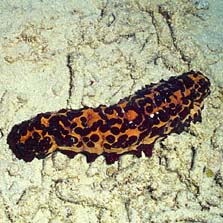
Though they are called cucumbers, they are invertebrates not plants. And, though they often look as if they are dead, they simply have a body well adapted to their lifestyle. |
|
Several species crawl around Caribbean reefs and all have names that describe their appearance, such as donkey dung, furry and three-rowed sea cucumbers. Yet there is no mistaking their close relationship; all are foot-long, slug-like, slow-moving creatures covered in nodules. Nodules on the underside of the body are podia with suction discs, enabling the sea cucumber to move. It is not difficult to work out which end is which of a sea cucumber, as they leave a trail of sand casts behind. One scientific team calculated that a sea cucumber might process between 500 and 1,000 tons of sand in search of food per year. Some species prefer to filter food from the water with tentacles around their mouth. |
 |
Not surprisingly sand goes in the mouth and out of the anus. Perhaps more unusual is the use of the anus to breathe. Water is drawn in through the anus and is forced over the respiratory trees and then exhaled through the same orifice as it was inhaled. The respiratory trees also have a part to play in the creature’s defensive armoury. Cuvierian tubes attached to the respiratory trees are pumped full of water and expelled, embroiling predators in a sticky mass of threads. |
|
Expelling internal organs is common practice in sea cucumbers. Another defensive ploy is to eject the body organs—intestines, respiratory trees and gonads—which gives the predator something to feed on while the sea cucumber escapes and regenerates its missing parts. |
|
| Not a great deal is known about the reproductive process of sea cucumbers. But if the thought of two sea cucumbers copulating brings a smile to your face, sorry; we do know that sperm and eggs are released into the water where chance is left to determine whether they encounter a sperm or egg. The result is a free-swimming larva, which metamorphoses several times before becoming a bottom crawler like its parents. This dicey strategy obviously works as we see many sea cucumbers on Caribbean dive sites. | |